


What materials are used in 3D printed insoles?
3D printing technology has dramatically changed the way insoles are produced. Whereas traditional insoles often consist of composite layers of foam, cork or plastic, 3D printing offers new possibilities with innovative materials. The choice of material determines not only the durability and support of the sole, but also its comfort and adaptability to individual needs.
What materials are used in 3D printed orthotics? And what properties make these materials suitable for podiatric applications?
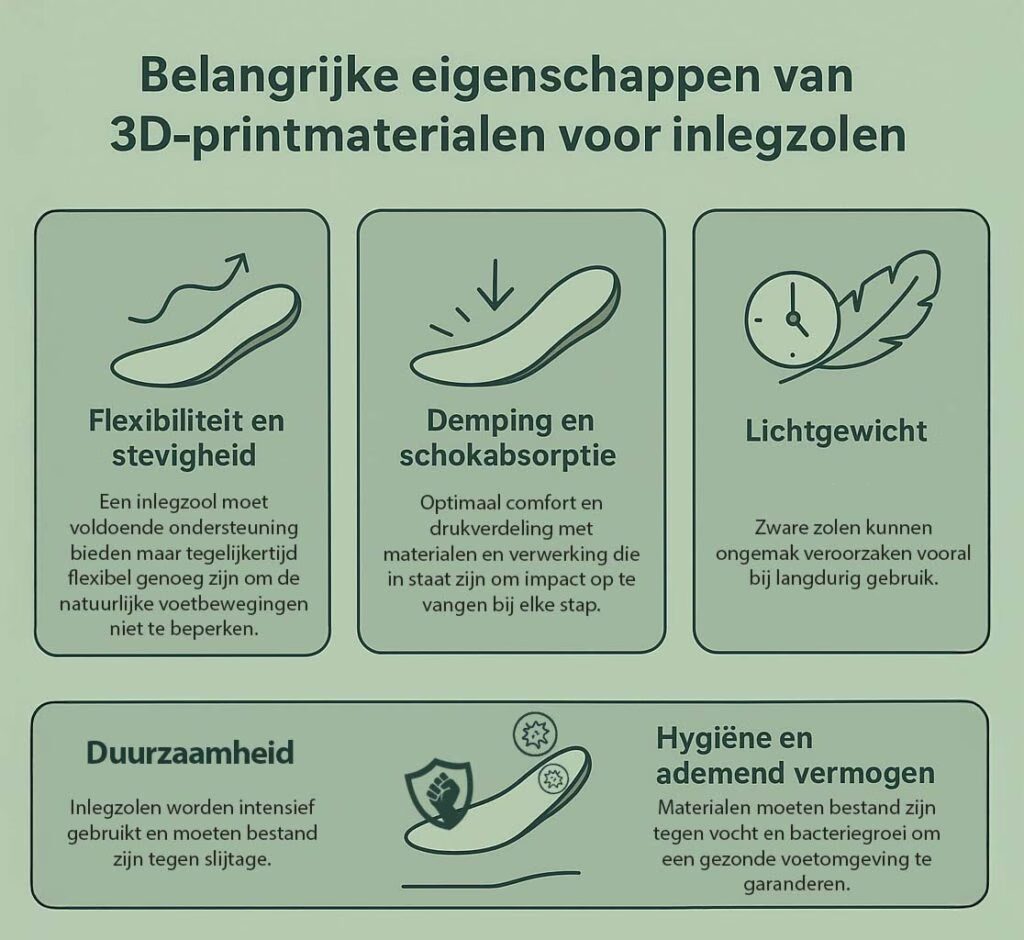
Important properties of 3D printing materials for insoles
A sole must meet specific requirements to be effective. Therefore, 3D printing materials are selected based on the following characteristics:
- Flexibility and firmness – An insole should provide sufficient support, but at the same time be flexible enough not to restrict natural foot movement.
- Damping and shock absorption – For optimal comfort and pressure distribution, materials must be able to absorb impact. Different hardnesses can be created in 1 printed sole.
- Durability – Insoles are used intensively and must withstand wear and tear.
- Lightweight – Heavy soles can cause discomfort, especially with prolonged use.
- Hygiene and breathability – Materials must be resistant to moisture and bacterial growth to ensure a healthy foot environment.
Commonly used materials for 3D printed insoles
1. TPU (Thermoplastic Polyurethane)
TPU is one of the most widely used materials for 3D printed insoles. It combines flexibility with strength, making it ideal for everyday, sports and medical applications.
Advantages of TPU: good balance between flexibility and support, hard-wearing and durable, resistant to moisture and bacteria, lightweight and comfortable.
TPU is often used in soles that require different zones with different hardnesses, accomplished within one printing process for optimal pressure distribution.
2. PA (Polyamide) – Nylon
Polyamide, better known as nylon, is a commonly used material in SLS (Selective Laser Sintering) 3D printing technology. It is a sturdy and wear-resistant material suitable for long-term use.
Advantages: very strong and durable, resistant to high loads, lightweight, good chemical and thermal resistance. Nylon is often chosen for soles that require extra strength and structural integrity.
3. TPE (Thermoplastic Elastomer)
TPE is similar in properties to TPU, but it is even more elastic and offers a softer wearing feel. This material is often used for orthotics where extra cushioning and flexibility are desired: high elasticity, excellent shock absorption, comfortable and flexible, resistant to tearing and abrasion.
4. SLA resins (Resin for Stereolithography)
SLA resins are less commonly used for insoles, but offer advantages for precision printed parts, cured with UV light: very high level of precision and detail, smooth finish without finishing, suitable for medical applications.
What material do we recommend for podiatrists?
For podiatrists transitioning to 3D printed insoles, TPU (Thermoplastic Polyurethane) is the best choice. This material offers an optimal balance of flexibility and firmness, making it suitable for everyday applications as well as sports and medical orthotics.
In addition, 3D printing with TPU makes it possible to produce soles directly in the field without post-processing. This saves time and ensures consistent quality without depending on external suppliers.
For podiatrists looking for an efficient, durable and high-quality solution, TPU is the ideal choice.

Qwadra newsletter
Don’t miss the latests updates and news for each of our solutions.
Inscription à la newsletter (EN)
* Please fill out the required fields